
Ever wondered why the dollar sign looks like an “S” with lines through it, or what that squiggly symbol before British pounds actually represents? You’re not alone. Currency symbols are everywhere in our globalized world, from international money transfers to stock market tickers, yet most of us never stop to think about their fascinating backstories.
Share your referral code with friends and family. When they sign up and complete a transaction, you earn points or rewards based on the active program.
*Rewards and mechanics may vary by program period. Terms and conditions apply.
What Are Currency Symbols and Why Do They Matter?
Currency symbols are special characters or signs used to represent different monetary units around the world. Think of them as the shorthand of international finance – instead of writing “United States Dollar” every time, we simply use “$”.
But these symbols aren’t just convenient abbreviations. They’re deeply rooted in history, politics, and cultural identity. Some evolved from ancient trading practices, others were designed by governments to project power and stability, and a few emerged from pure practical necessity.

In today’s interconnected economy, knowing these symbols helps you navigate everything from online shopping to reading financial news. Plus, it’s pretty impressive when you can casually explain why the British pound symbol looks like a fancy “L” at your next dinner party.
Most Common Currency Symbols You Should Know
Let’s dive into the symbols you’ll encounter most often in international finance and travel. These are the heavy hitters of the currency world.
1. Dollar Sign ($) – The Global Standard
The dollar sign is probably the most recognized currency symbol worldwide, and it’s not just for US dollars. Countries like Canada, Australia, Singapore, and many others use variations of this symbol.
The most widely accepted theory about its origin traces back to the Spanish “pieces of eight” coins that were common in early American trade. The “$” likely evolved from the abbreviation “Ps” for pesos, with the “P” and “S” eventually merging into the symbol we know today.
2. Euro Sign (€) – Europe’s Modern Marvel
The euro symbol is relatively new, officially introduced in the 1990s when the European Union was developing its common currency. The design was inspired by the Greek letter epsilon (ε) and represents the cradle of European civilization.
The two horizontal lines symbolize stability – something the EU wanted to emphasize with their new monetary system. Fun fact: the symbol was specifically designed to be easily readable and reproducible across all European languages and writing systems.
3. British Pound Sterling (£) – The Elegant “L”
The pound symbol comes from the Latin word “libra,” which means weight or balance. This makes perfect sense when you consider that currencies were originally based on weights of precious metals.
The distinctive crossed “L” design has remained virtually unchanged for centuries, making it one of the oldest currency symbols still in active use. It’s a testament to British financial tradition and continuity.
4. Japanese Yen (¥) – East Meets West
The yen symbol represents the Japanese word “en,” meaning circle or round. The two horizontal lines through the “Y” were added to distinguish it from the Chinese yuan, which uses a similar symbol but with one line.
Interestingly, this symbol also represents the Chinese yuan in international contexts, which can sometimes cause confusion in global markets.
Regional Currency Symbols Around the World
Beyond the major international currencies, different regions have developed their own unique symbols that reflect local culture and history.
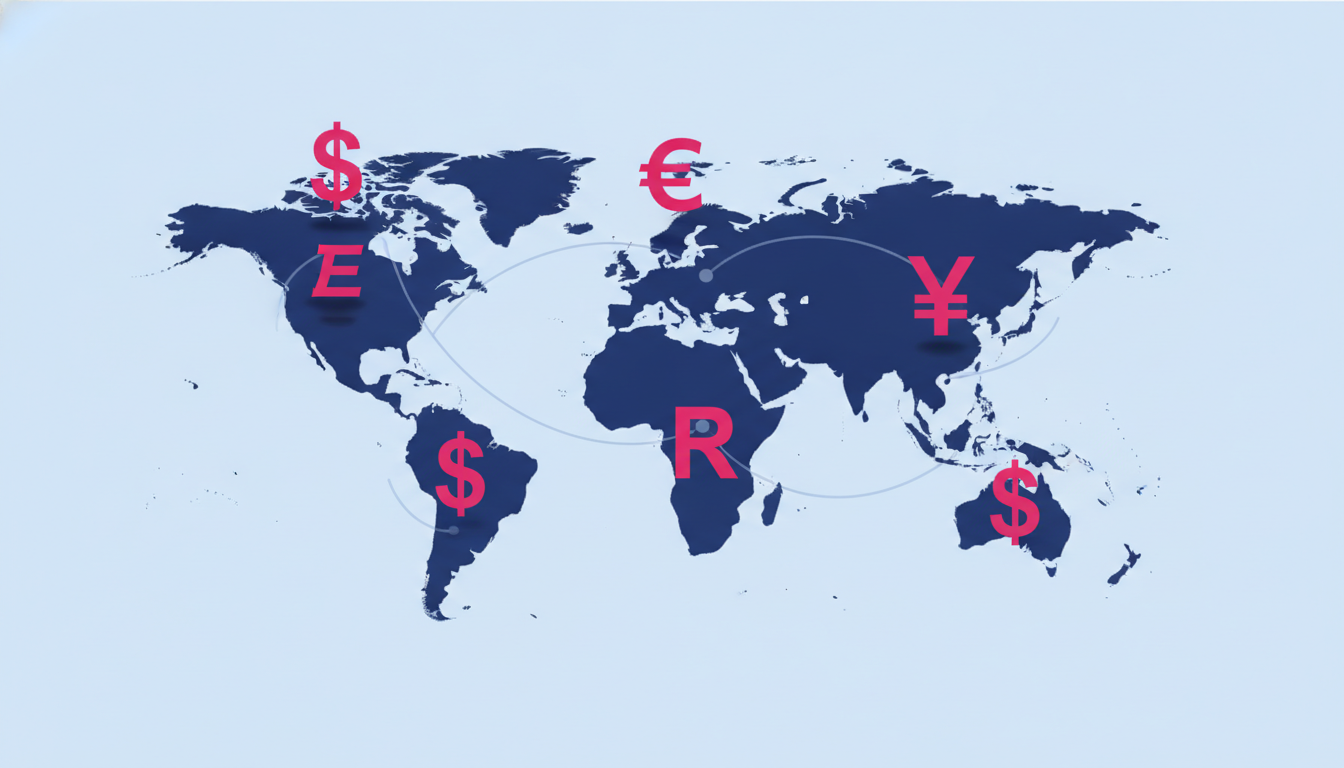
1. Asian Currency Symbols
Asia showcases incredible diversity in currency symbols. The Indian rupee (₹) symbol was officially adopted in 2010 and combines the Devanagari letter “र” (ra) with the Latin letter “R.” Thailand’s baht uses the symbol ฿, which comes from the Thai letter “บ” (bo baimai).
South Korea’s won (₩) features a distinctive “W” with two horizontal lines, while Indonesia’s rupiah typically uses “Rp” as an abbreviation rather than a unique symbol.
2. Middle Eastern and African Symbols
The Turkish lira recently introduced a new symbol (₺) in 2012, combining elements that represent the letter “T” and “L.” Many African currencies use abbreviated forms of their names rather than unique symbols, though South Africa’s rand uses “R.”
The Israeli shekel (₪) has one of the most distinctive symbols, combining Hebrew letters that spell out the currency’s name.
3. Latin American Variations
Most Latin American countries use variations of the dollar sign, but with their own cultural twists. Mexico’s peso uses “$” but sometimes adds “MX” for clarity in international contexts.
Brazil’s real uses “R$” to distinguish it from other dollar-using nations, while Argentina’s peso often appears as “ARS$” in global markets.
How Currency Symbols Evolved Over Time
The evolution of currency symbols tells the story of human civilization, trade, and technological advancement. Understanding this history gives you insight into how money itself has developed.
Ancient civilizations often marked their coins with symbols representing their rulers or gods. As trade expanded beyond local regions, merchants needed quicker ways to identify and record different currencies in their ledgers.
The printing press revolutionized currency symbols by standardizing their appearance. Suddenly, the same symbol could be reproduced consistently across different documents and countries. This standardization was crucial for international trade and banking.
Today’s digital age has brought new challenges and opportunities. Currency symbols must work across different computer systems, fonts, and digital platforms. The Unicode standard now includes hundreds of currency symbols, ensuring they display correctly whether you’re sending an email or updating a spreadsheet.
Using Currency Symbols Correctly
There’s actually a right and wrong way to use currency symbols, and getting it wrong can make you look unprofessional in business contexts.
Most currency symbols go before the amount (like $100), but some come after (like 100₽ for Russian rubles). When in doubt, follow the convention used by the country that issues the currency.
For international documents, it’s often clearer to use the three-letter currency codes (USD, EUR, GBP) alongside or instead of symbols. This prevents confusion when dealing with multiple currencies that share similar symbols.
Digital Currency and New Symbol Trends
The rise of digital currencies has created an entirely new category of currency symbols. Bitcoin (₿) now has an official Unicode symbol, and other cryptocurrencies are following suit.
These new symbols face unique challenges – they need to be instantly recognizable in digital formats while also working in traditional print media. The design process for modern currency symbols involves extensive testing across different platforms and use cases.
See Also: Complete List of World Currency Symbols
Perfect for community managers, group admins, content creators, or anyone who wants to help others send money abroad — and get rewarded for it.
- ✓Promote Transfez using your affiliate link or code
- ✓Earn a commission each time a referred user completes a transaction
- ✓Official program — full info page & T&Cs available
*Terms and conditions apply. Rewards are subject to change in accordance with program policy.
Download the Transfez App
The Transfez app helps you send money abroad faster, cheaper, and more efficiently. Jack Finance can also support your company's cross-border transactions. Sending money to family studying, working, or traveling overseas? Transfez has you covered. Available on Android and iOS — download now!